A First Visit to a Public Meeting: A Low-Fuss Preparation Plan
A first visit to a public meeting feels easier when you preview the agenda, choose one question to follow, and keep a simple term-and-question note.
A first visit to a public meeting is easier when you arrive with one thread to follow, not a plan to understand everything. A packet may contain dense staff language, familiar place names, and several items that matter to different people. You can prepare without mastering the whole system: preview the public agenda, choose one question, and bring a small place to record unfamiliar terms.
Start with the agenda
Find the meeting notice and agenda on the public body’s website, or ask its clerk where they are posted. Check the date, start time, location or access link, and whether the meeting is open to the public. The notice may also describe how public comment works, how to request an accommodation, or how to submit a written comment.
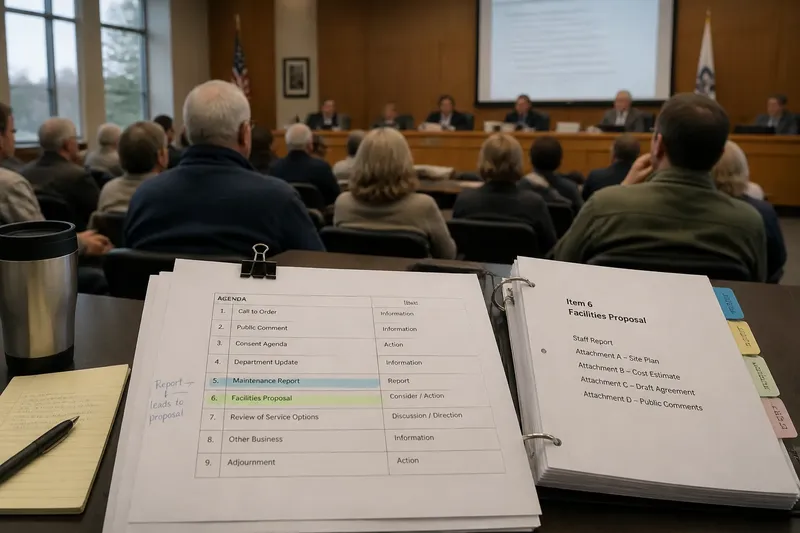
Read the agenda once from top to bottom before opening every attachment. Look for the order of business, the names of agenda items, and any item that connects to a place, service, or decision you already care about. A heading such as “parking changes” may be enough to identify your thread; the packet can supply the detail later.
Then look at the item itself. Is it for information, discussion, a public hearing, or a decision? The label can help you anticipate what kind of conversation may happen, though it does not tell you exactly what every speaker will say. If a staff report or map is attached, scan its opening explanation and any recommendation rather than trying to decode every page.
Make a short note of the item’s exact name and where it appears on the agenda. Meetings can move through routine business quickly, and your note gives you a reliable reference if the chair uses a shortened title. Think of the agenda as a bus timetable: it helps you locate a stop, but the actual conversation may take a different route.
Choose one question
A first visit is not an exam. Pick one honest question that helps you understand the item, and let it guide your attention. You might want to know what decision is being considered, which staff office prepared the recommendation, what information the decision relies on, or what happens after the meeting.
Keep the question open enough to follow the discussion. “What changes if this proposal moves forward?” can help you listen for effects, alternatives, and next steps. A question framed as an accusation may make it harder to notice the actual choices on the table. You do not have to agree with the proposal to ask for a clearer explanation.
Write the question in ordinary language, then add the agenda item beside it. If you hope to speak, check the meeting’s public-comment instructions and any deadline or sign-up process. If you are attending only to observe, there is no need to prepare remarks. Listening closely is a complete reason to be in the room.
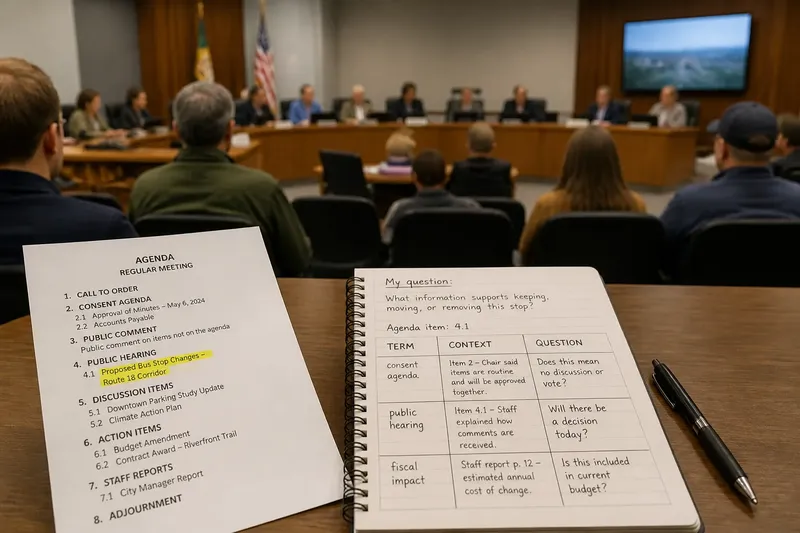
Say you want to understand a proposed change to a neighborhood bus stop. You might write, “What information supports keeping, moving, or removing this stop?” and note the agenda item’s name. During the meeting, you can listen for the information used, the options discussed, and whether a later decision is scheduled. That gives your attention a clear destination without requiring you to predict the answer.
Keep a term note
Public meetings often use words that sound ordinary but carry a specific administrative meaning: “consent agenda,” “referral,” “continuance,” or “fiscal impact.” Do not stop listening to look up each one. Mark the term, jot down the sentence around it, and return to the discussion. Context often reveals whether the term describes a document, a process, or a decision.
A compact note can use three columns or simple labels:
- Term: the unfamiliar word or phrase, copied as accurately as possible.
- Context: the agenda item or sentence where it came up.
- Question: what you still need clarified, such as “Does this mean a vote today?”
Leave room for page numbers or speaker roles if those help you revisit the packet. Avoid trying to write down every statement. A few precise clues are more useful than a transcript assembled from half-heard sentences.
If a term remains unclear, check the meeting packet, the public body’s glossary, or a later staff explanation. You can also ask the clerk how to direct a process question. Keep the distinction clear: a clerk can often explain how to find records or follow meeting procedure, while the staff member responsible for a program may be better placed to explain its technical substance.
Set up the visit
Before leaving, confirm the practical details: where to enter, whether the meeting is in person or online, and how to access any public materials. For an online meeting, check whether the public can listen without registering and how to submit a comment if that is your aim. For an in-person visit, note the room location and whether public seating is separate from the dais or staff area.
Bring the agenda on paper or on a device, plus a pen or note-taking app. A charged phone can help with the agenda, but silence notifications so the device does not compete with the discussion. If you want to refer to a packet page, save the file or write down the page number before the meeting begins.
Choose a modest goal for the visit: hear how one item is discussed, learn who answers a particular kind of question, or understand what follows a public comment period. A modest goal is not a small contribution. It gives you a way to notice something concrete, even if the agenda is long or the discussion moves into unfamiliar territory.
Check the published agenda and meeting instructions for the details that apply to that body; where a rule depends on local procedures or an organizer’s instructions, follow those directions. If you need an accommodation, contact the listed office in advance when possible so staff can explain the available process.
What should you listen for?
As the meeting moves from one agenda item to the next, use these questions to keep your notes focused. You do not need to capture every comment; look for the item’s status, the information you missed, and the next useful place to check.
How can I tell whether an item is up for a decision?
Look for wording such as “action,” “approval,” or “vote,” and listen for the chair to state what action is before the body. If the agenda says “discussion” or “information,” the item may not be scheduled for a decision at that meeting.
What if the discussion moves past my question?
Keep the question on your note and mark the point where the conversation changed direction. The answer may appear later in a staff report, a subsequent agenda, or a response from the relevant office.
Can I attend without speaking?
Yes, unless a particular event has a separate participation arrangement that says otherwise. Many public meetings include observers, and you can learn the room’s rhythm before deciding whether to speak at a future meeting.
What should I do if I miss a term?
Write down the part you did catch, such as the item name or the speaker’s role, and keep listening. You can check the packet afterward or ask a focused follow-up about that moment rather than trying to reconstruct the whole discussion.
Leave with a useful note
After the meeting, spend a few minutes turning your rough notes into three lines: what happened to your agenda item, what term you want to clarify, and what question remains. Separate what you heard from what you infer. For instance, “The board discussed two options” is different from “The board prefers the first option.” That distinction keeps your own record dependable.
If the item continues later, use the public body’s posted calendar or agenda page to see when it returns. If you need a document or a clarification, identify the office or contact named in the packet and make a concise request. A specific question tied to an item is easier to route than a broad request to explain the whole meeting.
The point of a first visit to a public meeting is not to catch every detail. It is to leave knowing where your question fits, which terms deserve a second look, and what public information can help you follow the next part. That small, well-kept thread can make the next agenda feel less like a wall of official language and more like a set of choices you can inspect.