Minutes or Notes: What Each Record Is Meant to Capture
Minutes or notes: learn what each record should capture, how to tell them apart, and which one helps you act accurately after a public discussion.
Minutes or notes serve different jobs after a public discussion: minutes create an official account of proceedings, while notes help a person remember and work with what was said. If you are responsible for recording a civic committee meeting, choosing the right form begins before anyone speaks. A useful record is not simply the longest one; it is the one suited to its purpose.
Start with the record’s purpose
First, find out what record the meeting is expected to produce. A public body may require formal minutes for its official record, while a staff member, participant, or community group may also keep personal notes for follow-up. These can sit side by side without competing: one documents the meeting as an institution, the other helps someone remember and act.
Minutes generally capture the meeting’s essential business: who convened it, which matters were considered, what decisions were made, and what actions were assigned. They are not normally a transcript. Notes can be more flexible. They might preserve a question to revisit, an explanation that clarifies a proposal, or a reminder to send a document after the meeting.
Ask who will use the record and for what. A clerk preparing an official account needs a reliable record of decisions and procedure. A resident tracking a concern may want the name of the department asked to respond and the wording of a commitment. Trying to make one document serve both needs can leave the official record cluttered and the personal account hard to use.
Check the meeting rules
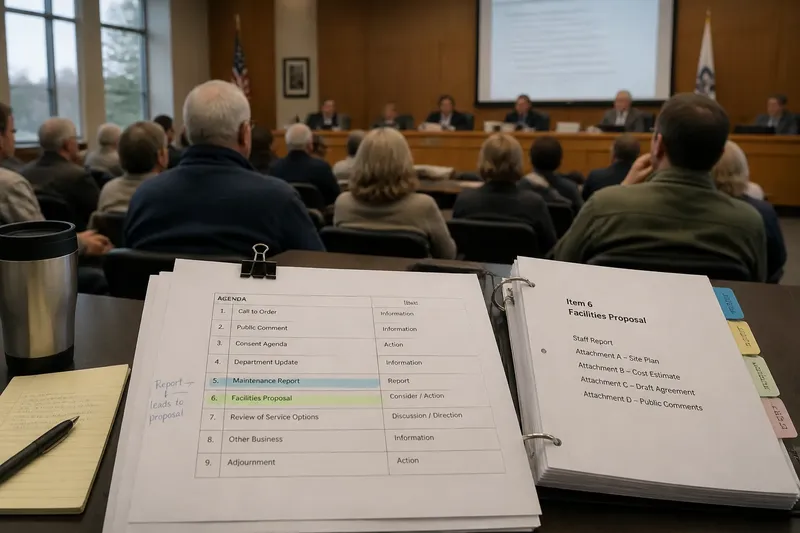
Before recording, check the body’s rules and the record’s intended status. Local procedures, public-record requirements, and the chair’s directions can shape what belongs in formal minutes. A meeting packet, clerk’s guidance, or established template may specify how to record attendance, motions, votes, closed sessions, or corrections to earlier minutes.
Where a requirement depends on local rules or a specific body’s instructions, follow those rather than assuming every committee uses the same format. Keep private working notes distinct from a document submitted for approval. That separation makes it clearer which record is the institution’s account and which is a personal aid.
If you are attending as a member of the public, you usually do not need to create formal minutes. You can make concise notes for yourself, provided you follow any rules about recording or sharing information. If you are assigned to prepare minutes, ask who reviews and approves them, how corrections are handled, and where the accepted version is kept.
Capture the essentials
For formal minutes, focus on a small set of facts that lets a reader understand what happened without reconstructing every exchange:
- The body or committee name, meeting date, location or format, and start or end information required by its practice.
- Members present, absences, and other attendees when the record calls for them.
- The topics considered, recorded in a clear order.
- Formal motions or proposals, the person making them when required, and how the body disposed of them.
- Decisions, votes, referrals, and assigned actions, including the responsible role or person and any stated deadline.
- Public comments or staff presentations in the level of detail the body’s practice calls for.
Do not turn a disputed point into a settled fact. If a motion did not pass, record that outcome accurately. If the group asked for more information rather than making a decision, say so. The distinction is like a receipt beside a shopping list: minutes establish what the body did, while notes can remind you what to look into next.
Personal notes can preserve more context, but select details that will still make sense later. Record a speaker’s name or role when relevant, the question raised, the response given, and any follow-up you want to make. Mark uncertainty rather than quietly filling gaps. A brief note such as “confirm which department owns this request” is more useful than a guessed answer written as fact.
Write notes for later use
During discussion, listen for decisions, commitments, changes, and unresolved questions. These are easier to retrieve than a running account of every sentence. Use short phrases, leave space to add a clarification, and distinguish what happened from what you think it means. For example, “committee requested revised map” records an action; “members dislike the proposal” is an interpretation unless the discussion supports that wording.
After the meeting, review your notes while the discussion is still fresh. Expand abbreviations that another person might not understand, identify any action you need to take, and flag details that need checking against an agenda packet or official record. Do not silently convert a recollection into an institutional decision. If the approved minutes are later published, compare them with your notes when you need to confirm the body’s formal action.
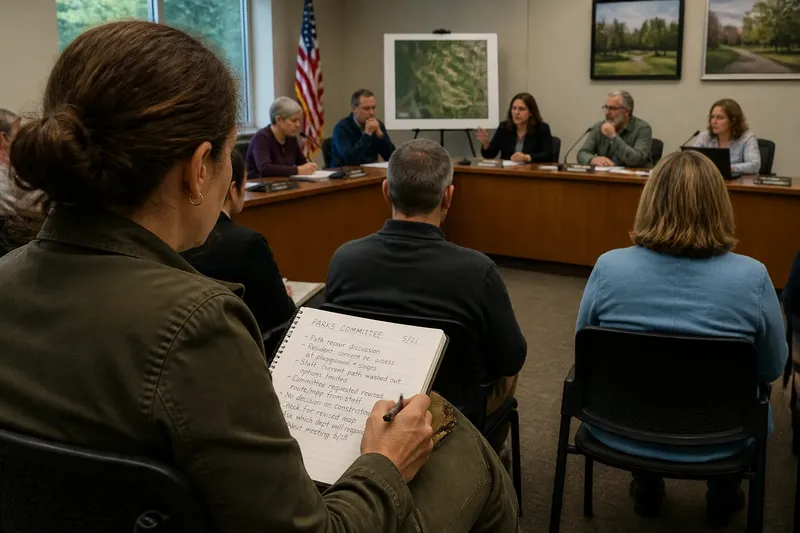
Imagine you attend a parks committee discussion about a path repair. The committee asks staff to return with a revised route and makes no construction decision. Your notes could preserve a resident’s concern about access and remind you to check for the revised map. The minutes should capture the request to staff and the absence of a final decision, rather than implying that the repair was approved.
Keep each record useful
Use formal minutes when the record needs to show the body’s proceedings and decisions. Use personal or working notes when you need context, reminders, or a record of questions to pursue. If you are preparing both, create them for their separate readers: keep the official account neutral and concise, and make private notes easy for you to search and understand.
Store notes responsibly, especially if they include personal details or information that should not be circulated casually. Label drafts clearly so they are not mistaken for approved minutes. When sharing a record, state whether it is an official version, an unapproved draft, or an individual’s notes; that small distinction can prevent confusion about what the body actually decided.
Which record do you need?
Are minutes a transcript?
No. Minutes usually record essential proceedings and outcomes rather than every speaker’s full remarks. A transcript or recording, if one exists, is a different kind of record.
Can personal notes correct minutes?
Notes can help you identify a possible omission or wording problem, but they do not change the official record on their own. Use the body’s correction process or contact the responsible clerk if you believe an approved account is inaccurate.
Should notes include opinions?
You may record your own reaction, but mark it as your interpretation rather than presenting it as something the meeting decided. Keeping observations separate from facts makes later review clearer.
What if nobody made a decision?
Record that the matter remained open, was deferred, or was referred for further work, as appropriate. Do not treat discussion or a request for more information as approval.
When choosing between minutes or notes, start with the question a future reader will ask: “What did the body formally do?” calls for minutes; “What should I remember or follow up?” calls for notes. Keeping those purposes distinct makes both records more dependable and easier to use.