The Agenda Is a Route Map for a Public Meeting
A public meeting agenda helps you follow the sequence, identify possible decisions, and connect each item with the papers that explain it.
A public meeting agenda is easier to follow when you read it as a route map, not a list of announcements. Its order, item descriptions, and supporting papers show how the meeting is expected to move from one subject to the next—and where you may need more context.
That map can be imperfect. An item may be hard to interpret, a paper may seem to be missing, or discussion may move somewhere the heading did not suggest. Reading the agenda alongside its materials can help you identify what is clear, what remains uncertain, and what question would resolve the gap.
When the sequence feels abrupt
A change of subject between agenda items can seem sudden, especially when decisions appear alongside routine business. The agenda may be arranged around meeting procedure or a work plan rather than a reader’s preferred storyline. A report may come before a related decision because members are expected to hear the report first; an earlier item may also establish context for a later one.
Read the headings immediately before and after the item that feels out of place. Then look for words such as “report,” “consider,” “approve,” “update,” or “recommend.” They can suggest different kinds of business, though their precise meaning depends on the body’s own practice. A report often conveys information; a recommendation may invite a decision; an update may be for discussion without a stated action.
If two items appear connected, check whether their papers refer to each other. One may say that a later decision depends on an earlier report, or that a proposal follows from prior direction. If no link appears, do not assume the items are formally connected just because they concern the same subject. The chair or meeting clerk may be able to clarify the intended sequence.
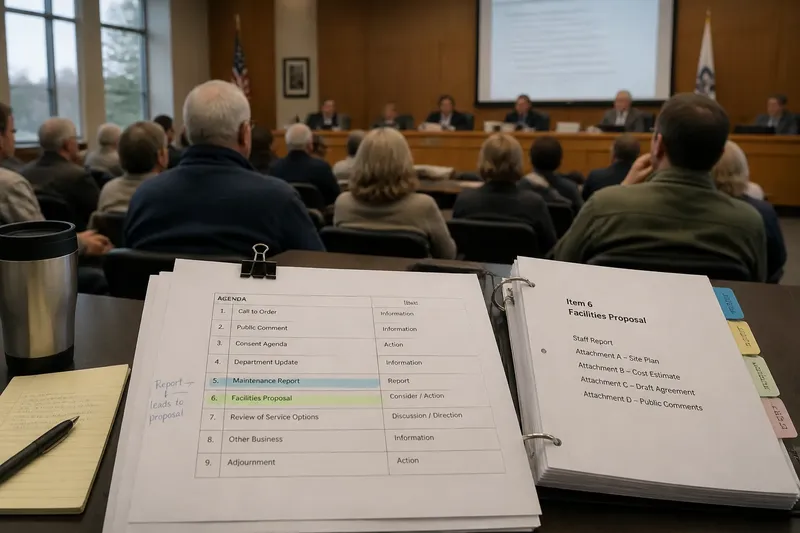
Imagine a public board agenda places a maintenance report before a facilities proposal. The report describes an issue, while the proposal asks the board to consider a response. Reading them in that order helps explain why the proposal follows; it does not establish what the board will decide.
When an item title is vague
A heading such as “Department update” or “Old business” tells you little about the subject or likely action. The item may have been carried forward from an earlier meeting, use a standard label, or rely on an attachment for its details. The title is a doorway, not necessarily a full description of what is inside.
Look for an item number, the name of a department or committee, and any action word. Then compare the heading with the paper’s title, summary, and requested action. A heading that says “Transit update,” paired with a paper titled “Route proposal,” may point to a more specific discussion than the agenda line reveals. The mismatch is a reason to read the paper, not proof that the agenda is incorrect.
If the paper still does not identify the question before the meeting, note what is missing: the subject, the requested action, or the decision-maker. A focused query is more useful than a broad complaint. Ask whether the item is for information, discussion, or a requested vote, and whether the attached paper is the version members will consider.
Some agendas use procedural labels that have a particular meaning in that organization. A “consent” or “routine” grouping, for instance, may collect items expected to be handled together, but local rules and practice determine how members can ask to separate an item. Check the body’s agenda notes or meeting guidance before treating a label as a promise about discussion.
When papers are hard to match
Supporting papers may be posted as separate files, bundled into a packet, or linked by short references. A reader can lose the thread when an agenda cites “Attachment A” but files are named by department, date, or subject. That may be a document organization problem rather than evidence that the paper is absent.
Use the agenda’s item number as your anchor. Search the packet for that number, then check the cover page and headings for a matching subject. If the agenda links to a staff report and several attachments, open the report first: it may explain what each attachment contains and how members are being asked to use it. A map, draft policy, and correspondence file can serve very different purposes even when they sit under the same item.
Keep the agenda and packet open side by side, or note the item number beside each file you consult. This is like using tabs in a folder: a small bit of labeling makes it easier to return to the right place when discussion moves. If a link fails or a cited attachment is not there, record the exact item number and document name, then contact the clerk or staff office responsible for the meeting materials.
Do not assume every attachment is a complete account of the topic. A paper may summarize a proposal and point to a separate appendix for details. Check its references and attachments list before deciding that the packet stops short of the material it mentions.
When the action is unclear
An agenda can identify a subject without making the intended action plain. “Review of service options” could mean members will hear a presentation, discuss alternatives, provide direction, or choose among proposals. Compact drafting can leave the purpose unclear when a short agenda line must name a topic, presenter, and requested action.
Look in the staff report for a section called “Recommended action,” “Requested direction,” or something similar. Read its wording closely. “Receive” or “discuss” may signal a different purpose from “authorize” or “adopt,” but interpret those words alongside the body’s procedures and the full item materials. The heading alone may not tell you whether members can act on a proposal.
Check whether the agenda identifies the item as a public hearing, presentation, or decision item. These labels can help explain the expected procedure, but they do not replace the body’s rules. Where a particular right, deadline, or decision process matters, consult the official meeting notice or ask the clerk rather than relying on an informal interpretation.
If no paper explains the action, write down the narrow question that would resolve the ambiguity: “Is the board being asked to choose an option tonight, or only to discuss the report?” That separates the subject from the meeting’s purpose without presuming an answer.
When the packet arrives late
Sometimes the agenda appears before all the papers, or an attachment is added later. A report may still be in preparation, the agenda may have been posted in stages, or a supplemental packet may be issued separately. The agenda’s publication date and any “late materials” or “supplemental” notice can help you identify whether you have the latest set.
Check the meeting page for a revised agenda, a supplemental file, or a notation beside the item. Compare document titles and dates rather than relying on a saved link alone. If the item matters to your understanding, read the most recent paper and note what changed from an earlier version. A changed attachment may add context, revise a recommendation, or correct a detail; comparison helps distinguish among those possibilities.
When a referenced paper remains unavailable, contact the listed meeting clerk or department and name the meeting, item number, and missing document. Ask whether another version is available and whether later materials have been posted. Keeping the request tied to the item makes it easier to distinguish a missing attachment from a broader question about the meeting schedule.
When discussion moves off the map
Even a clear agenda cannot script every exchange. Members may ask questions, request clarification, or respond to public comment in ways the short description does not predict. The agenda is a guide to intended business, not a transcript or a promise that discussion will follow a fixed path.
When the conversation seems to drift, return to the item’s stated purpose and the action requested in its paper. Ask whether the new point supplies context, proposes a different action, or raises a separate subject. That distinction helps you follow the discussion without treating every departure as a formal change to the agenda.
If the chair announces a change in order, note the item number or title and what has moved. A later item may be taken early, or a scheduled item may be postponed. The posted sequence remains useful, but meeting announcements tell you where the route has changed.
Questions about agenda reading?
These quick answers address common uncertainties about sequence, papers, and changes during a meeting. Check the body’s own procedures whenever a local rule affects what members can do.
Does agenda order show what will be decided?
Not by itself. Order can show the intended sequence, while the item description and supporting paper are more likely to identify whether members are being asked to receive information, discuss a subject, or take action.
Why are papers listed separately from the agenda?
Meeting pages often keep the agenda brief and attach reports or exhibits as separate files. Match them by item number, title, and references in the staff report rather than assuming every file name will repeat the agenda wording.
What should I do if a paper is missing?
Check the meeting page for a supplemental packet or revised agenda, then contact the clerk or responsible office with the meeting date and item number. Ask whether the document is available and whether the item’s materials have changed.
Can the meeting change the listed order?
Some bodies can rearrange business under their procedures, but the applicable rules differ. Listen for an announcement and consult the body’s published meeting guidance if the change affects what you need to follow.
Read for connections
To read a public meeting agenda, connect three things: where an item sits, what its description says, and what its papers ask members to consider. Each supplies a different clue. If one is missing, the others can narrow the uncertainty, while a precise question can identify what still needs clarification.
Before the meeting, mark the item numbers you care about and note any papers that seem to explain or depend on one another. During the meeting, update those notes when the order changes or a new document is mentioned. That small record gives you a reliable route back through the agenda without mistaking its map for the meeting itself.